
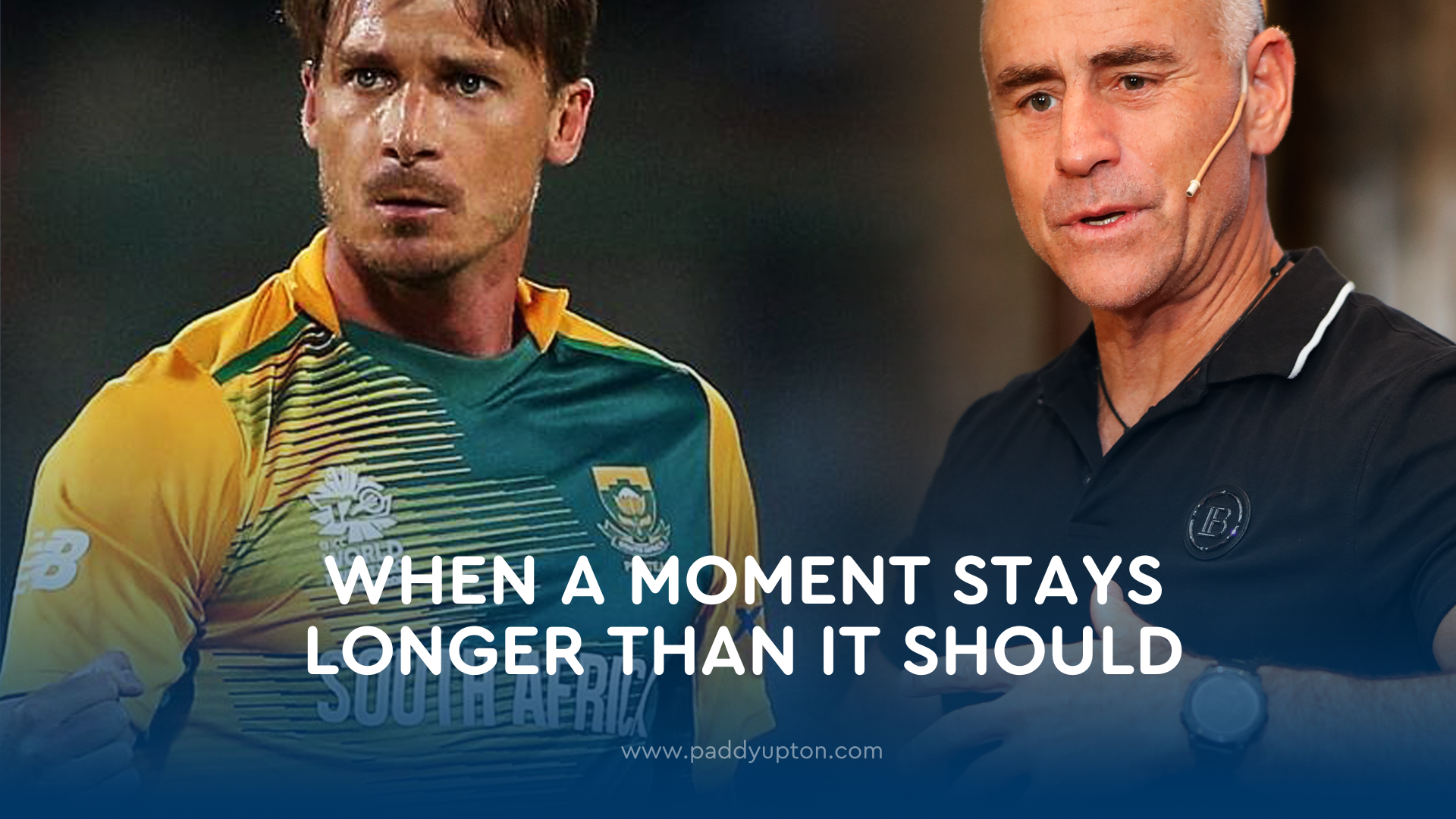
By Paddy Upton
There are moments in sport that pass quickly for the viewer but stay much longer for the person living them. The final over Dale Steyn bowled in the 2015 World Cup semi-final is one of those moments. New Zealand needed eleven runs. They got those eleven runs. The scoreboard moved on within seconds. Dale didn’t.
When we sat together in my lounge for this conversation — both of us fresh from an icy swim down the coastline below my house — I asked him about that over. Not for the cricket detail, but for the human experience that followed. His honesty surprised me, even after knowing him for more than a decade.
He said he wasn’t quite the same in a cricketing sense after that night. Not because of one ball, but because of everything that gathered around it: the expectations, the responsibility he carried as a senior player, and the quiet inner work that came afterwards. What stood out was how long it took him to find himself again. He needed time to understand that the World Cup wasn’t decided by that single moment. There were many other parts of the game that contributed. It took a while for that perspective to settle.
This is something most athletes know well. A moment ends on the field, but the (bottled up) emotions and the meaning can stay. You wake up the next day, and the world expects you to be back to zero, ready to carry on. Yet inside, you may still be working through the weight of what happened. Dale described that part openly. It wasn’t dramatic. It was simply human.
The reality he shared reminded me of how often high-performance cultures reward the surface — the “I’m fine” responses, the tidy answers, the quick resets. Dale said he walked around for a long time showing teammates that he was okay, partly because he didn’t want younger players to doubt themselves. He carried his concern quietly so they wouldn’t carry theirs more heavily. That’s something many people in competitive environments will recognise: the instinct to protect others while you’re still stitching yourself together.
Later in the conversation, he mentioned watching the replay of that over for the first time six years later, during lockdown. With the world already feeling heavy, he didn’t expect how strongly it would hit him. When the ball went for six, he stepped outside and cried. Not because of the cricket, but because of the story he had lived around that moment. It was the first time he allowed himself to revisit something he had tried very hard to forget.
That honesty is one of the reasons people who know Dale speak of him the way they do. On the field, he was one of the fiercest competitors the game has seen. Off the field, he is gentle, grounded, and often the first person to go over and greet someone’s dog on the beach. The intensity of his on-field persona was something he learnt to step into, piece by piece, by studying the fast bowlers he admired. It helped him compete. It didn’t always help him inside himself. He even spoke about the energy it took to keep that persona alive on days when he was exhausted before bowling a single ball.
Listening to him describe all of this, I found myself reflecting on something that comes up often in high performance. Many of the hardest moments aren’t about the skill, the tactics, or the result. They’re about the meaning we attach to events, and the stories those meanings create over time. And without space to talk honestly — as people, not performers — those stories can take longer to unravel than they need to.
When he said, “I had to understand that I didn’t lose the World Cup because I went for six,” it wasn’t said defensively. It was said with perspective. One moment rarely carries the whole story. A game is made up of many parts, many decisions, many contributions. Yet when pressure is high, it’s easy for one moment to occupy more space than it deserves.
That’s one of the quieter truths of high performance: perspective often arrives slowly, especially when the spotlight has been bright. Sometimes it comes years later, when life gives you the distance to see the moment more clearly.
What I appreciated most about this conversation wasn’t the cricket detail. It was the honesty around what followed. The long road back to balance. The slow rebuilding of trust in yourself. And the understanding that a moment, no matter how public, doesn’t define who you are.
These are the conversations I hoped this podcast would open — not just the highlight-reel stories, but the ones that sit underneath them. The ones that speak to the human experience behind performance. In Dale’s case, the journey after that World Cup over was as meaningful as the moment itself. Possibly more so.
And for anyone navigating their own version of a difficult moment, there’s something reassuring in knowing that even the best in the world sometimes need time to find their way back.

Paddy Upton is a renowned mental coach, leadership consultant, and former high-performance coach to elite international athletes. With a background in sport psychology and years of experience working with top cricket teams, he now helps individuals and organisations unlock their full potential through talks, workshops, and his unique A-Game methodology.

