

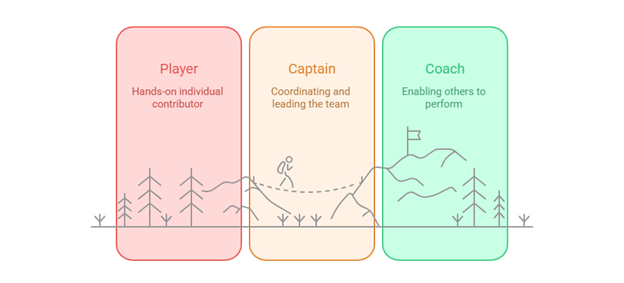
Most founders I meet are so busy steering the ship that they don’t notice when their role needs to change. In the early days you’re the player — delivering the goods yourself. As the business grows, you need to become the captain — still playing, but now coordinating others, aligning communication, and keeping the team moving in the same direction. Eventually, the role shifts again. You become the coach — your job is no longer to perform, but to enable others to perform.
It’s not delegation. It’s a fundamental shift in mindset — from “my success” to “our success.” And it’s one of the most important transitions any founder will make.
The evolution looks like this:
In my work with elite athletes and now with founders, I see the same principles of high performance repeat themselves. Whether you’re chasing an Olympic medal or scaling a business, the fundamentals hold true.
Mental fitness starts with the “boring” stuff: sleep, nutrition, exercise. These aren’t optional extras; they’re the foundation. In sport, a few nights of bad sleep will quickly erode performance. In business, it’s the same — poor physical routines weaken decision-making, resilience, and creativity. Top up your own battery before expecting to perform at your best.
When self-worth is tied to results, you ride a constant emotional rollercoaster — high when things go well, crushed when they don’t. That volatility costs you clarity and energy. Learn to hold your identity separate from your latest valuation, quarter, or win. Success doesn’t make you a better person; a setback doesn’t make you less of one. This isn’t a one-off lesson — it’s ongoing work.
We tend to analyse failure and celebrate success. High performers interrogate both. The day after a result — win or lose — ask: What did we do well? and What will we do better next time? This keeps improvement constant and ensures success isn’t left to chance.
The flood of social media hacks and influencer tips can be as unhealthy for the mind as junk food is for the body. The core principles of performance haven’t changed in thousands of years — consistency, preparation, character, emotional regulation. Commit to what works and practise it deliberately.
Early in my time with the Indian cricket team, MS Dhoni told me quietly, “Paddy, you don’t have to talk every time.” Leadership isn’t about asserting yourself at every opportunity; it’s about reading the room and adding value only when it’s needed.
The startup journey is full of complexity — shifting rules, moving targets, and no referee to keep it fair. But the same fundamentals that help an athlete perform under the spotlight can help founders thrive in uncertainty: prepare like a professional, look after your energy, keep perspective on results, and focus relentlessly on enabling your team to perform.
✅ Mental wellness starts with physical discipline
✅ Leadership is a shift from doing to enabling
✅ Your worth is not tied to business results
✅ Mastery is doing simple things consistently, not chasing trends


FOR ELITE ATHLETES
